
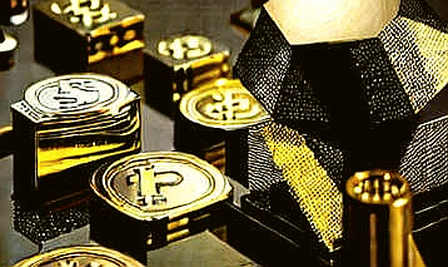
In September, the People's Bank of China will issue the world's first AI-themed legal tender set: one gold coin with an 80-yuan face value and two silver coins at 5 yuan each, for a combined face value of 1.8 million yuan. Maximum mintage: 50,000 pieces. The metal allocation — 50 kilograms of gold, 600 kilograms of silver — represents roughly four seconds of daily global gold trading volume. By every measurable economic metric, this event is a rounding error.
And yet it matters.

Central banks do not decorate their currency by accident. Commemorative coin themes are approved at the highest level of monetary authority. Iconography on legal tender is state messaging with a minting press behind it. The PBoC has chosen to put neural circuitry on Chinese money. That is not a monetary operation. It is a declaration.
The question is not whether this moves M0. It does not. The question is what it signals about the policy trajectory of the world's second-largest economy.
Commemorative coins occupy a strange legal category in China's monetary system. They are recorded in M0 at face value but never circulate. An 80-yuan gold coin sells for thousands of yuan, priced by metal content and collector premium, not by its nominal denomination. The balance sheet impact on the PBoC is effectively zero. No liquidity, no interest rate signal, no reserve requirement change. Anyone treating this as a monetary policy event has misread the instrument.
I have spent years modeling the transmission channels between central bank actions and crypto asset prices. This particular issuance sits outside every channel I track.
What makes it analytically useful is the design governance. The PBoC's rules permit designers to use AI tools as assistants, but prohibit direct submission of AI-generated content. Read that carefully. The central bank is simultaneously legitimizing AI as a productive tool and drawing a boundary around human authorship. That tension is the most honest piece of AI policy signal in this entire announcement.
The coin themes run: artificial intelligence basic research, technology for good, and AI+ applications across industries. The visual vocabulary — chips, brain-shaped circuits, binary digits, keys — constitutes industrial policy reduced to numismatic form.
The signal operates on four levels, and each deserves separate weight.
First, institutional endorsement. The PBoC is the apex of China's financial hierarchy. Every commemorative theme it approves becomes part of the official state narrative. By selecting AI, the PBoC has aligned the currency itself with the "new productive forces" strategy. Globally, this is the first time a major central bank has put AI on legal tender. That is soft power executing a specific geopolitical maneuver: claiming a position in the global AI governance narrative before the EU or the United States can mint their own version.
Second, the "AI+" formulation echoes the "Internet+" campaign of 2015. That campaign preceded a wave of fiscal support, infrastructure investment, and regulatory accommodation. The parallel matters because "AI+" is not a technology label — it is an industrial integration agenda. The message to provincial governments, state-owned enterprises, and capital markets is that AI adoption across traditional industries will receive policy protection.
Third, "basic research" is placed first. In the context of US-China technology competition, this is code for self-reliance. The chokepoint anxiety of 2022 and 2023 — GPU export controls, advanced lithography restrictions, model weight security — has translated into a policy emphasis on foundational capability. Putting that phrase on a coin is a low-cost way to signal continuity with the chokepoint technology breakthrough strategy.
Fourth, "technology for good" is governance language. It tells international audiences that China intends to participate in AI ethics and safety discourse. It mirrors the rhetorical structure of the EU AI Act and the UN's AI governance resolutions.
Based on my experience auditing tokenomics and modeling incentive structures, I can state this plainly: the coin's mechanism is irrelevant. The incentive signal, however, is real.
The obvious trade is to read this as a bullish catalyst for AI-related equities and, by extension, AI-token narratives in crypto markets. That trade is lazy. This coin allocates no capital, changes no incentive, and subsidizes nothing. If A-share AI names rally on a 1.8 million yuan mintage, the rally is a confession of narrative hunger, not a response to fundamentals. Volatility is the tax on unproven consensus.
The deeper contrarian read is about labor. The rule that designers may use AI but not submit AI-generated content is a microcosm of the central contradiction in every government AI strategy: embrace the technology's efficiency, protect the human's prerogative. This is not a coherent position. It is a compromise between industrial ambition and social stability. The coin literally encodes the contradiction.
There is also a meaningful risk that this is a one-off. Symbolism is the cheapest form of policy. If the PBoC's next issuance returns to zodiac animals and revolutionary heritage sites, the AI coin becomes a curiosity, not a watershed. The market-implied probability of follow-through is currently too high relative to the cost of producing a symbolic artifact.
Ignore the metal. Track the follow-through. I will be watching for three confirmations: an upgraded national AI development plan from the State Council, a national AI industry fund exceeding one hundred billion yuan, and the theme of the PBoC's next commemorative issuance. The coin is a thermometer, not the fever. Institutions, not iconography, will determine whether this signal carries any heat.